


Производи


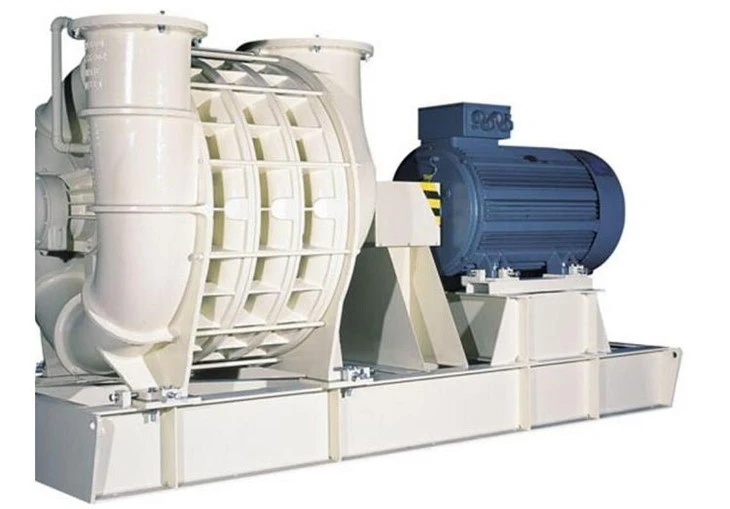


Fans are widely used for ventilation, dust removal and cooling of factories, mines, tunnels, cooling towers, vehicles, ships and buildings, ventilation and air induction of boilers and industrial furnaces; cooling and ventilation of air-conditioning equipment and household electrical appliances
Funkcija
Fans are widely used for ventilation, dust removal and cooling of factories, mines, tunnels, cooling towers, vehicles, ships and buildings, ventilation and air induction of boilers and industrial furnaces; cooling and ventilation of air-conditioning equipment and household electrical appliances; drying and conveying of grains, inflating and propelling of wind tunnels and hovercrafts, and so on.

Fan classification can be divided into centrifugal, axial, inclined flow (mixed flow) and cross-flow types according to the direction of gas flow.
(1) Centrifugal fans. The gas flows axially into the impeller of the fan and then flows mainly in the radial direction. These fans are made according to the principle of centrifugal action, and the products include centrifugal ventilators, centrifugal blowers and centrifugal compressors.
(2) axial flow fan. Airflow axial into the impeller of the fan, approximate in the cylindrical surface along the axis of the direction of flow. These fans include axial flow ventilators, axial flow blowers and axial flow compressors.
(3) Rotary fan. Utilizing rotor rotation to change the volume of the air chamber to work. Common varieties include Roots blower and rotary compressor.
Fan according to the use of the local fan is divided into the pressure into the fan (hereinafter referred to as the pressure into the fan) and explosion-proof motor placed outside the runner or in the runner, explosion-proof motor in the explosion-proof sealing chamber of the extraction of the local fan (hereinafter referred to as the extraction of the fan).
Fan according to the form of pressurization can also be divided into single-stage, two-stage or multi-stage pressurized fan. For example, 4-72 is a single-stage pressurized fan, while high-end fans are multi-stage pressurized fans.
Fans can be divided into negative pressure fans, low-pressure fans, medium-pressure fans, and high-pressure fans according to pressure.
According to the outlet pressure (boost) is divided into: ventilators ( Less than or equal to 15,000 Pa), blowers (15 ~ 350,000 Pa), compressors ( Greater than or equal to 350,000 Pa).

(1) can be divided into: volumetric: reciprocating and rotary; turbine: centrifugal, axial, mixed-flow and cross-flow, jet.
Ventilators generally refer to the turbine type, i.e., centrifugal, axial flow, mixed flow, cross-flow and other forms.
Cross-flow fans: have higher dynamic pressure and can get flat airflow.
(2) According to the use of different materials can be divided into; iron casing fan (ordinary fan), glass fiber reinforced plastic fan, plastic fan, aluminum fan, stainless steel fan and so on.
(3) According to the direction of gas flow can be divided into: centrifugal, axial flow, inclined flow (mixed flow) and cross-flow type.
(4) According to the direction of flow after the gas flow into the impeller can be divided into: axial fan, centrifugal fan and inclined flow (mixed flow) fan.
(5) According to the use can be divided into: pressure into the local fan and explosion-proof motor placed outside the runner or in the runner, explosion-proof motor placed in the explosion-proof sealing cavity of the extraction type local fan.
(6) According to the form of pressurization can also be divided into: single-stage, two-stage or multi-stage pressurized fan [1].
In addition, the amount of noise and vibration are the main fan design indicators. Flow, also known as the volume of wind, the volume of gas flowing through the fan in a unit of time; pressure, also known as the wind pressure, is the gas in the fan pressure elevation value, there are static pressure, dynamic pressure and the full pressure of the points; power refers to the input power of the fan, that is, the shaft power. The ratio of the effective power of the fan to the shaft power is called efficiency. The efficiency of the fan at full pressure can reach 90%.
Popularne oznake:
ne
Можда ти се такође свиђа


Pošalji upit
